Roshar
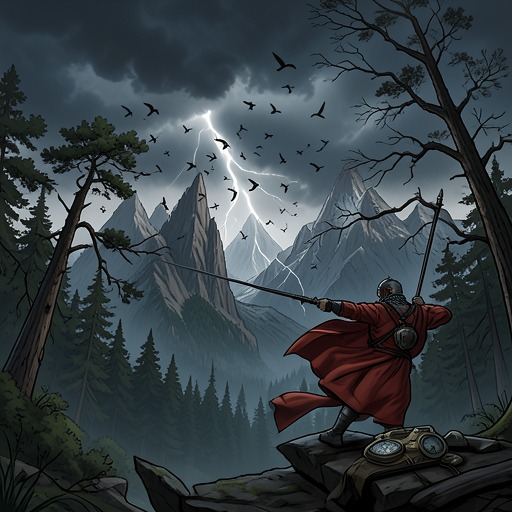
The Way of KingsRoshar is a world of stone and extraordinarily powerful storms, and its defining significance lies in the way those storms have shaped nearly every form of life and civilization. Animals hide in shells, trees retract their branches, grass withdraws into the ground, and cities are founded where the terrain provides shelter. Across this hostile environment, war, trade, scholarship, religion, and migration form an interconnected network whose pressures converge on the Shattered Plains and on the long-forgotten legacy of the Knights Radiant.
Environment and Settlement
Roshar’s ecology is an adaptation to recurrent highstorms rather than an independent natural order. Living things protect themselves by withdrawing, hardening, or sheltering: shells shield animals, branches pull inward, and grass retracts into soil that is often nearly absent. Human settlement follows the same logic. Cities are built only where topography offers protection, making geography a condition of political and economic life rather than merely a scenic feature.
The highstorms are violent enough to dictate schedules and expose weaknesses in infrastructure. Storm dates can be predicted mathematically, and Kaladin’s father had made a hobby of forecasting them, successfully choosing the correct day eight times out of ten. Yet prediction does not eliminate vulnerability. A leaking wagon can remain structurally strong enough to withstand the winds while still spraying icy rainwater through its cracks, and enslaved travelers shelter inside it with little comfort or control over their circumstances. The storm therefore operates simultaneously as a natural fact, a logistical problem, and a measure of social inequality.
Roshar’s built environments display different responses to the same danger. Sesemalex Dar is constructed in enormous troughs whose raised lips keep water from streaming in from the stone plain; cracks serve as drainage channels and protect the city from flooding. At the edge of the Shattered Plains, the Parshendi build simple structures from crem and stone in craterlike formations. Their willingness to rebuild if highstorms destroy those buildings contrasts with the elaborate defensive engineering of Sesemalex Dar, showing that resilience can take the form of either permanent infrastructure or repeated reconstruction.
Regions and Connected Peoples
The world’s distances are repeatedly crossed by workers, merchants, scholars, soldiers, and enslaved people. The Purelake stretches for hundreds of miles as a transparent, warm, shallow body of water, generally no more than six feet deep and often only calf-deep. Ishikk fishes there in lake sandals, carrying buckets on a pole across his shoulders. His poor catch and the irregular tides make the lake feel like an economic and religious environment at once: a bad fishing day is interpreted through the provision of Nu Ralik and as a sign that worse days may be coming.
Trade connects Roshar’s cultures through objects that reveal different material economies. At a meeting with Thresh, Vstim presents a heavy crate of scrap metal, much of it shaped like shell fragments and some pieces resembling wood. To Rysn, the contents look like garbage that has inexplicably been Soulcast into metal; to Thresh, the shipment is welcome and valuable, especially because he hopes for more metal from distant lands. The exchange makes commerce a form of translation between local expectations, foreign resources, and the technologies of Soulcasting.
Cultural difference is equally visible in customs and law. The Purelakers regard uncovered shoulders in sunlight as necessary to health, while the people of Sesemalex Dar treat respectful foreigners as relatives from afar. Foreign visitors cannot own homes or shops there, but may receive dinner at any residence they approach if they offer fruit as a gift. Such details place Roshar’s societies in relation to one another without reducing them to a single cultural norm: religion, hospitality, property rights, dress, and trade vary across the same storm-bound world.
War, History, and the Shattered Plains
The Shattered Plains are the most concentrated expression of Roshar’s political and ecological violence. The landscape is ruined and inhospitable, yet it has become the site of a war in which ten armies fight separately against a single foe. Kaladin, once willing to abandon a medical apprenticeship for a spear in order to protect his younger brother, is reduced to slavery within this conflict and struggles to save men whom commanders regard as expendable. Dalinar Kholin commands one of the competing armies, linking the battlefield to the larger crisis of leadership, memory, and moral responsibility.
The war is inseparable from the world’s buried past. Centuries earlier, the ten consecrated orders known as the Knights Radiant fell, but their Shardblades and Shardplate remain. These weapons and suits of armor can turn ordinary people into nearly invincible warriors, and kingdoms are traded or wars won because of them. Roshar’s political order is therefore organized around relics whose original purpose has been forgotten or contested. The surviving Shards are both military resources and evidence of a vanished civilization.
The landscape also carries signs of threats beyond ordinary warfare. In the Prelude, Kalak encounters a dying thunderclast: an enormous stone creature with a vaguely skeletal form, long limbs emerging from granite shoulders, broken riblike projections, and deep red eyes that fade as it dies. The sight recalls that Kalak has been killed by hands like those before, placing the creature within a history far older and more terrifying than the current campaigns. Later, Dalinar witnesses a vision in which the land trembles, rocks shatter into dust, and an approaching wall of dust signals an approaching force. Roshar’s geology thus becomes an instrument of historical memory and apocalyptic warning.
Knowledge, Religion, and Perception
Roshar is divided not only by geography but by competing interpretations of its past. Dalinar is fascinated by the ancient text The Way of Kings and is troubled by overpowering visions of ancient times and the Knights Radiant, to the point that he has begun to doubt his sanity. His experience turns the world into a contested archive: visions may be evidence, delusion, or warning, and the difference cannot be settled by ordinary political authority.
Scholarship reaches across the same distances as trade and war. Shallan Davar travels to study under Jasnah Kholin, an eminent scholar and notorious heretic. Her genuine love of learning is entangled with a plan to steal from Jasnah, while her research into King Gavilar’s murder begins to uncover secrets concerning the Knights Radiant and the true cause of the war. Roshar’s history is therefore not safely contained in libraries; investigation can alter present loyalties and expose the instability beneath established explanations.
Religious interpretation varies sharply between regions. The people of Sesemalex Dar worship Jezrien as their only god, but do not accept him as a figure within the Vorin religion. The Parshendi possess a collective musical culture expressed through humming, chanting, and drums marked with painted handprints. Their music is so coordinated that separated singers can appear to share the same tempo, tune, and lyrics. These practices are observed by outsiders who do not fully understand them, creating a recurring contrast between what Roshar’s peoples know about themselves and what neighboring cultures assume about them.
Narrative Significance
Roshar’s world-building turns environmental pressure into a common structure beneath radically different lives. A slave wagon, a fishing ground, a foreign market, a fortified city, a battlefield, and a scholarly chamber are all shaped by the same storms, yet each reveals a different response to danger: prediction, shelter, trade, rebuilding, domination, or inquiry. The world’s physical constraints do not produce social unity; instead, they intensify distinctions of class, nationality, religion, and power.
At the same time, Roshar’s geography creates a global history in motion. Metal moves between strange lands, foreigners cross borders under distinctive legal customs, servants are compared with the Parshendi, and travelers carry stories of cities, gods, and peoples into military camps. The result is a world whose regions remain culturally specific while participating in shared systems of exchange and conflict.
The decisive tension is between adaptation and recurrence. Roshar’s inhabitants have learned to survive storms through biology, architecture, mathematics, custom, and endurance, but the ancient powers associated with thunderclasts, the Knights Radiant, and the Voidbringers are returning to the horizon of history. The world can withstand another season of storms only by confronting the deeper catastrophe that its surviving ruins and visions have been warning about.